Into the detail
The following sections go into more detail about the proposed solution
Engagement and Consensus
Two key conditions must be met in order for a decision to be legitimate:
Engagement defines the breadth of participation.
Consensus defines the depth of agreement.
Both are explicit and defined by the group.
How It Works
The Cast
The core elements that combine to produce a flexible and scalable voting platform.
The User
An individual participant whose identity is verified by the host or wider community.
The Group
A purpose-oriented container for users and the subjects they collectively decide.
Subjects can be shared between groups allowing specialist groups to provide artifacts for other groups to make use of.
A group known for specialising in inclusive behavioural standards could agree on a code-of-conduct (CoC) which is then adopted by another group.
Updates to the CoC automatically propagate to the adopting group.
That group can choose, at any time, to change the source of their CoC or they may decide to adopt a custom standard internally.
Groups can also be hosted and managed by different organisations while still being connected; a pattern known as "federation".
This maintains some of the ease-of-use qualities of a centralised system while offering organisations full autonomy (and responsibility)
The Subject
The core unit of decision-making.
A subject represents something to be decided - a proposal, rule, value, or outcome.
Its behavior is defined by its subject type. (see here for an initial list of subject types)
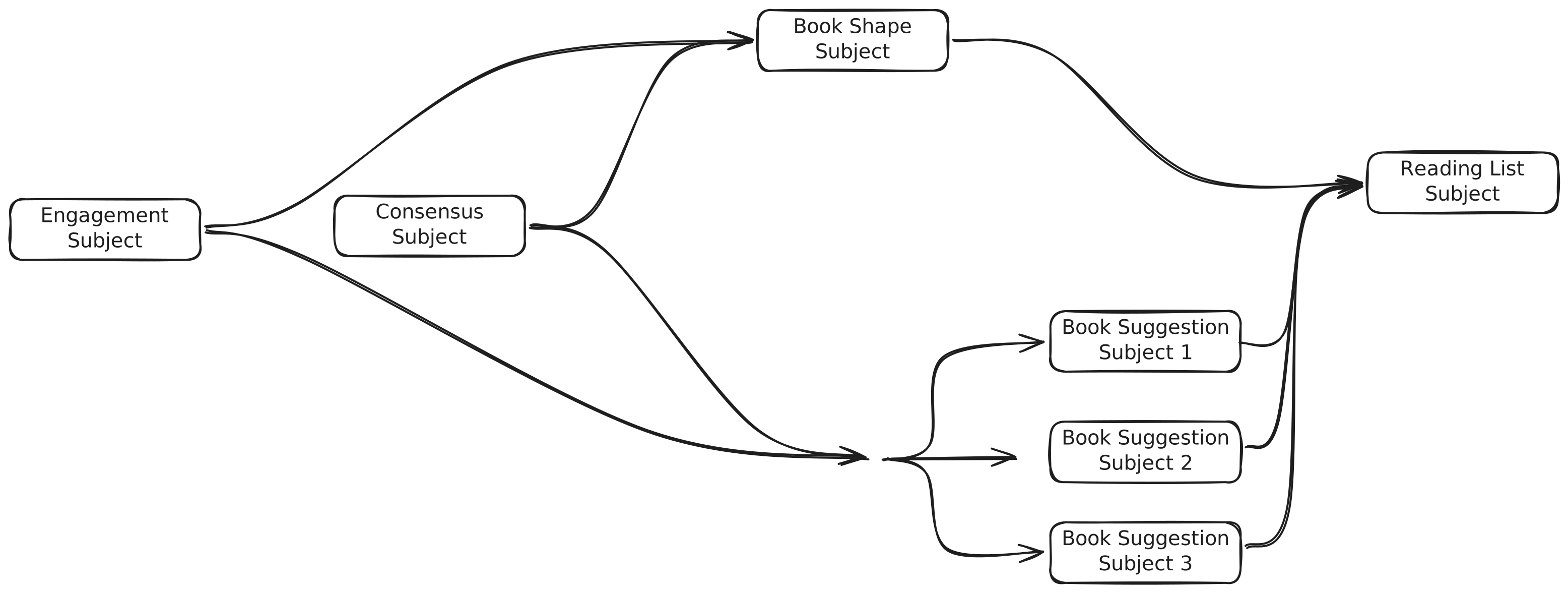
Subjects can feed into one another - for example, one subject defining the engagement threshold for another. More on this in the next section.
The Vote
A user’s input on a subject.
The form of a vote depends on the subject type.
Votes are positive expressions of intent or preference.
Disapproval is expressed using Rejections (next).
Rejection
A universal safeguard.
Any subject - regardless of type - can be rejected by a simple majority.
A rejected subject is marked illegitimate and becomes inactive.
Authors of a rejected subject can simply create a new subject in a form that has wider appeal
No rule is above the group (except this one).
Association
A relationship between subjects.
Associations allow subjects to influence or reference one another.
What an association means depends on the subject types involved.
Influence Example:
Reference Examples:
Decisions can shape other decisions
Subjects don’t exist in isolation.
One subject can define the structure, parameters, or meaning of another.
This allows nuanced, comprehensive and modular agreements to be built from simple, connected parts that evolve over time.
Status propagation
Subjects have two primary states: Active and Inactive.
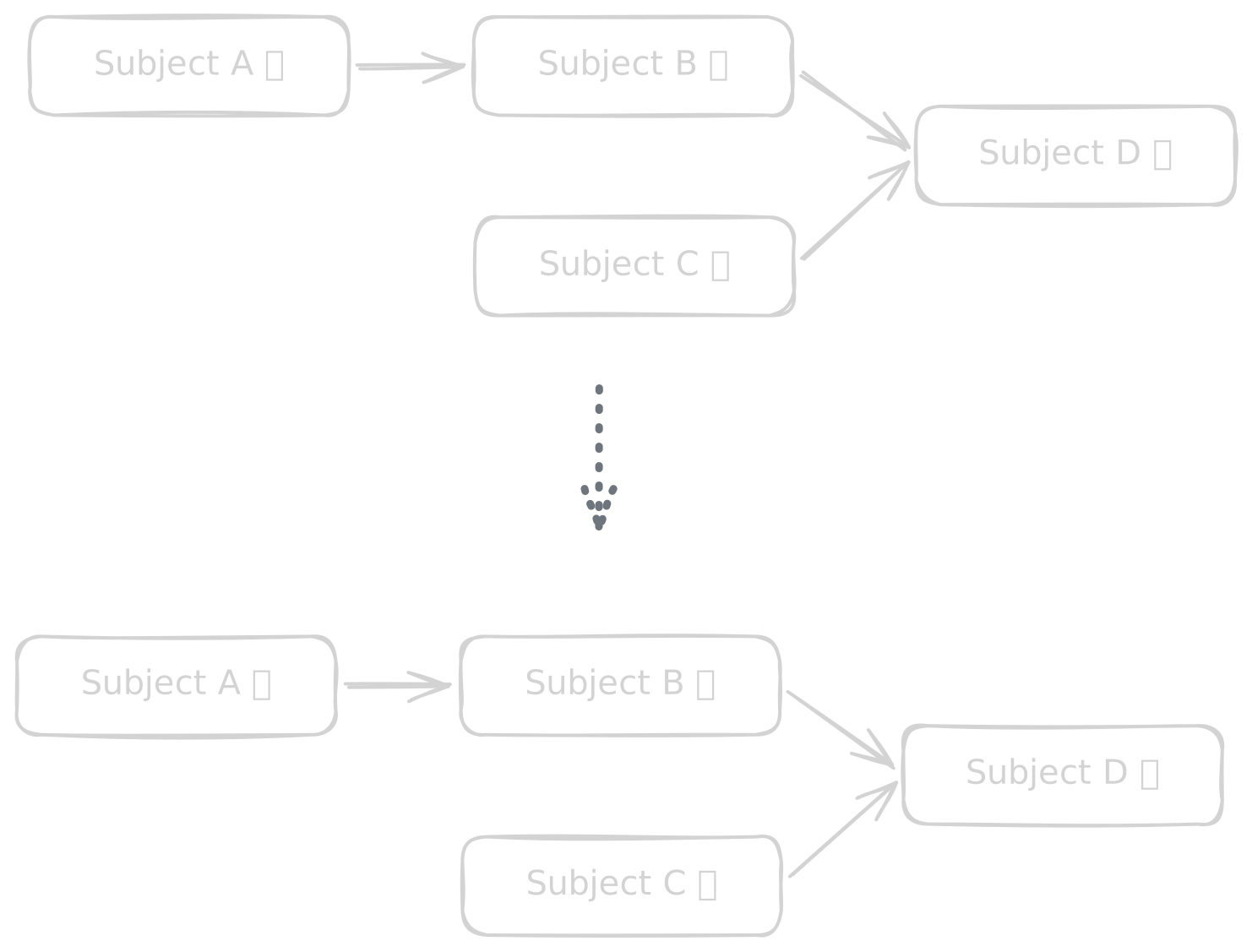
Where one subject feeds into a parameter of another, that subject must be active before the dependant subject can become active.
User Status
Like subjects, users can either be Active or Inactive. A highly sensitive yet crucial dimension that needs to be explored. Some considerations that could affect a users status:
Who counts is critically important.
Tallying the results
Vote tallying in So Vote is not a one-time calculation. It is a continuous process that maintains the legitimacy of connected subjects over time. Because subjects can influence one another, tallying requires updating both individual results and the wider network they belong to.
1. Gathering Votes
During the first phase we gather both positive votes and rejections for a subject and calculate the outcome and status of the subject.
2. Calculating New Result
Calculate both the new outcome value and status (i.e. active/inactive) of the subject.
3. Updating Dependent Subjects
Once the subject has been updated with a new value we move onto any other subjects that use it's outcome
Shapes
Before we decide, we need to agree what we’re even deciding.
A Shape subject allows a community to define what something is made of - what information, fields, or components are required before it can be decided on.
A book club maintains a prioritised list of books to read.
But what qualifies as a “book suggestion”?
Is it:
Shapes provide a way for the community to first agree on what information they need. The outcome from a shape subject defining what a book is can then feed into the shape parameter of the book list which then knows what information is required in a new reading suggestion.
Subject Types
The building blocks that all decisions are made out of.
They can be used individually or composed by other subject types to represent more complex outcomes.
Each subject type will have distinct criteria, result behaviour and vote input format, though, many will share characteristics (e.g. all subject types will have an engagement threshold parameter)
Subject parameters can either be set to specific values when the subject is created or derive their values from the result of other Subjects.
Text

A free text subject.
Users can make their own suggestion or up-vote someone else's.
Number

A subject for reaching consensus around a number.
Binary

The simplest type of subject; producing a yes/no result.
Conflict

Represents a conflict between two or more subjects.
Once a conflict has been accepted by the community, they may or may not choose to take action such as de-activating or changing the value of subjects.
Shape

Represents the shape and parameters of an entity. For example a group name would be a text subject with between 1 and 200 characters.
List

An ordered list of entities. Users can set their order preference of existing items as well as adding new items themselves
Comment

A comment associated with another subject.
Security
Voting systems must contend with additional security concerns that are very well documented in literature. It's a widely held view in academic circles that online voting will never be adequately secure.
Rather than focusing on these domain, specific problems early, we propose a user centred approach to first find a compelling user experience in low-stakes environments and once found, using it as a starting point to challenge underlying assumptions and explore the security problem space for opportunities.
Get Involved!
Register for updates
Join the development group
Relevant Literature
Reading materials that inform our build-out of a democratic alternative
State of democracy
Research into the state of democracy around the world.
Security
Literature examining alternative forms of governance and community organisation.
Governance Models
Literature examining alternative forms of governance and community organisation.
Submit literature for us to read
We're always looking for new material to read. But more than that we're looking for knowledgeable people to join the development group.